Some entrepreneurs think work happiness is soft. Fluffy. Something for HR people with too much time on their hands. I understand that reflex, but I don't share it.
To me, work happiness is an organization's most important KPI. Not because I'm romantic about people in the workplace. But because the numbers demand it.
In my work at JobAligner, I talk daily with directors and business owners who treat work happiness as a vague, unmeasurable concept. Even though they do measure how much revenue an employee generates, how much customer satisfaction there is, how many sick days are taken. Only the variable that best explains all those results, they leave untouched.
That can be different. This blog explains what work happiness is, why it's crucial for your organization, and how to make it measurable.
Let's start with what research teaches us. Employees who feel good at work are demonstrably 12% more productive. That's not an estimate or a feeling, that's the outcome of research from the University of Warwick. Those same employees take less sick leave, leave the organization less quickly, and structurally perform better.
As a business owner or director, you look at numbers all day. Revenue, margin, turnover, absence. But the variable that most influences all those numbers, most organizations barely measure. Or not well enough. Or once a year through an anonymous survey that conceals more than it reveals.
What I see with our clients: organizations that take work happiness seriously see a decline in sick leave and voluntary turnover within 12 months. For this reason alone, work happiness is not a nice-to-have. It's the explanatory variable behind your performance.
I searched for a good definition of work happiness, but couldn't find one. So I formulated one myself. The definition of work happiness is the happiness you experience when you hold positive thoughts, feel positive emotions, feel good in your own skin, enjoy your work, feel fulfilled by using and developing your own talent. And feel that you can contribute to a higher goal of the organization.
This definition emphasizes that work happiness isn't limited to just the workplace. Work happiness touches every facet of someone's life and, as a result, also influences a large part of an individual's life happiness. And the reverse is also true: the degree of happiness in someone's personal life partly determines their level of work happiness. I notice this strong interconnection between work happiness and life happiness is often underestimated.
Work happiness and feeling happy in life are therefore inseparably connected. It underscores the importance of recognizing the profound influence of work happiness on our overall well-being, and vice versa. For a better understanding of the definition of work happiness, let's first dive into the specific elements that together make up work happiness.
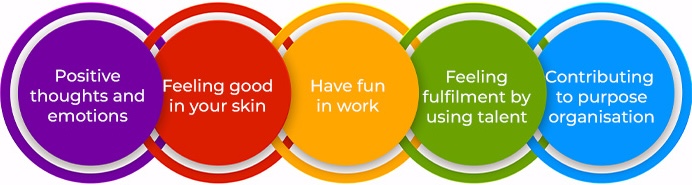
Understanding the components that together make up the DNA of work happiness is fundamental to promoting fulfillment, enjoyment and job performance in the workplace.
Here's first a summary of the key components of work happiness:
At its core, work happiness consists of holding positive thoughts and feeling positive emotions. So it's about fostering a positive mindset in the workplace. A mindset where optimism and enthusiasm thrive, even in the face of challenges. This positivity doesn't just increase satisfaction at work, it also carries over into someone's personal life. In other words: a positive mindset contributes not only to work happiness but also to greater life happiness.
Experiencing comfort and ease in the workplace is a crucial part of work happiness. When employees can be themselves, express their ideas, and genuinely contribute to the organization, it contributes to an inclusive work environment. Feeling good in your own skin therefore contributes to increasing work happiness!
Enjoyment at work is about the feeling of pleasure or satisfaction you experience while carrying out specific tasks or projects. The work needs to offer enough challenge. And, if possible, align well with the employee's interests. Of course, every employee has to deal with tasks they enjoy less. But aside from that, the fun factor is a real multiplier for increasing work happiness.
Feeling fulfilled at work through using and developing your personal talent is of the utmost importance. JobAligner's work happiness formula emphasizes the importance of drawing fulfillment from the tasks you carry out daily by putting your talent to use.
Understanding how your own role fits within the company's larger mission and goals gives a profound sense of meaning, which makes employees put in more effort. This brings the circle full: work happiness encourages employees to commit to the organization's higher goals. And at the same time, contributing to those higher goals creates even more work happiness.
By paying attention to these components, employees and employers can together contribute to a company culture that promotes work happiness. Each of these work happiness components reinforces the other. And creates a positive feedback loop that extends beyond the boundaries of the office.
In the following sections, we examine why making work happiness a priority is so important. In other words: why should you, as an employer, treat the theme of work happiness as a top priority?
A work environment that prioritizes happiness has a stimulating effect on the individual, the family and society as a whole. Employees who find fulfillment in their tasks enjoy their interactions in the workplace. They're driven by a sense of purpose. And have a greater chance of a fulfilling life. Experience shows that a work environment where people genuinely enjoy their work and feel valued is a success formula.
Understanding why work happiness matters isn't just about numbers and statistics! It's also about recognizing the personal fulfillment and growth it can bring to both managers and employees.
Employee satisfaction and the business benefits of work happiness
In addition to the benefits mentioned above, there are more reasons why you, as an employer, should treat the theme of work happiness as a top priority. When employees experience more work happiness, they become more productive, creativity increases, the relationship between managers and colleagues improves, sick leave costs decrease, innovation rises, the number of burnout cases drops, staff turnover decreases, and the company's reputation is strengthened.

It's undeniable that work is now present throughout our lives. Emails and phone calls follow us home. In our free time, we often find ourselves engaged in work-related conversations. So even when the office is closed, we struggle to fully let go of work. The same applies when meeting colleagues in our free time. There too, we often keep talking about work, which further strengthens the connection between the two worlds.
This interplay directly affects the workload experienced by employees and managers. This is because distractions from personal circumstances can undermine work focus, reduce productivity and even lead to more work stress. And more work stress leads to a greater experience of workload.
One of the crucial factors for work happiness is finding the right balance between work and personal life. A good work-life balance allows employees to fulfill their professional obligations with more enjoyment, get more done, and experience personal well-being at the same time. Once again, an indication that work happiness is very important for both employee and employer. And when it comes to a good work-life balance, enjoying your life comes first.
In one of my interviews with Ruut Veenhoven, also known as the Happiness Professor, Ruut had the following to say about this:
"Enjoying your work makes life even more enjoyable, but what's actually more important: if you enjoy your life, you usually enjoy your work more too. Employers think employee satisfaction can only be achieved by improving their work happiness. It turns out, however, that employee productivity depends more on their life satisfaction than on their job satisfaction."
Various factors in employees' personal lives play a major role in achieving life happiness. The most important factor of life happiness is health. So as an employer, don't just look at happiness in the workplace, but also at the life outside of it, which has a major influence on someone's work performance. What's the best thing an employer can do to safeguard a good work-life balance for their employees? According to Ruut Veenhoven, it's identifying personal challenges and offering support.
Improving work happiness: a shared responsibility
Experiencing work happiness has, on one hand, to do with the employee's perception of their state of mind. After all, the employee themselves is responsible for the thoughts and emotions they attach to the situation in the workplace. Everyone experiences work happiness in their own way. So a joke from a manager might be experienced as funny by one employee and as sarcastic or outright offensive by another.
On the other hand, the employer is responsible for creating the business conditions that safeguard work happiness and safety in the workplace. Managers who are empathetic and connect with employees from the heart contribute to this. The same goes for managers who make an effort to inspire employees to develop their talent and step into their strength.
Both the employer and the employee need to take action. And because work happiness and life happiness are so closely connected, creating a workplace where employees feel they can grow both professionally and personally is a joint effort. As is building a company culture that offers support in dealing with stress and the unique challenges of the modern (digital) world.
AI and robotics can contribute to work happiness by streamlining repetitive tasks, reducing workload, and giving employees the chance to focus on more creative and meaningful aspects of their work. When thoughtfully implemented, automation can free up time for employees, improve work efficiency and increase satisfaction.
In addition, apps such as JobAligner's can also help improve work happiness. I'll continue this blog with a brief overview of JobAligner's integrated work happiness formula.
At JobAligner, we've developed an integrated work happiness formula in which hard business objectives are optimally achieved by paying attention to the human side.
JobAligner's clients get access to their own Work Happiness App, including their own organizational community. In addition, employees weekly answer questions that influence their personal well-being, both inside and outside of work.
Based on the output, work happiness statistics and improvement plans are periodically generated. Together with leadership, I draw up an implementation plan featuring the most important work happiness boosters. The improvements are then implemented in the workplace. Seeing is believing, and this way work happiness is guaranteed to rise!
That question has been answered. Work happiness increases productivity by 12%, lowers absence and reduces turnover. The three basic psychological needs, autonomy, growth outlook and meaningful contribution, are the explanatory variables behind those results.
What makes a successful approach to work happiness extra challenging is the fact that work happiness and life happiness are so strongly connected. As an employer, you share responsibility for a good work-life balance for your employees. This requires genuine connection and involvement from both employer and employee. As an employer, you'd do well to identify personal challenges and offer support.
And last, but not least. Because work happiness is a shared responsibility of both employer and employee, both need to take action. In other words: an effective approach to work happiness requires both a top-down approach and a bottom-up approach.
At JobAligner, I help organizations structurally measure, understand and improve work happiness through an integrated approach that goes beyond an annual measurement. Curious what that means for your organization? Request a demo.